Polyester's approach to trading, lending, and asset management is built on a set of foundational concepts.
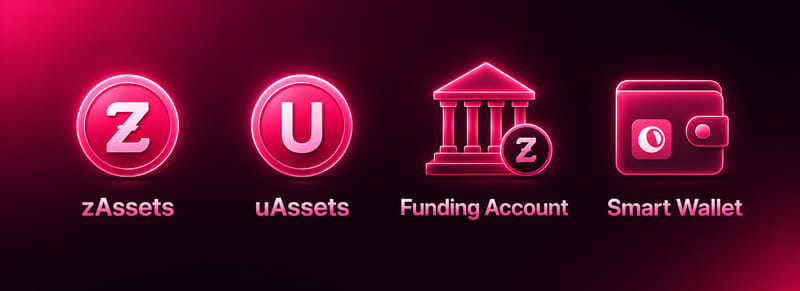
Two of them are specific to Polyester's design: zAssets and uAssets.
The Funding Account and smart wallets are familiar ideas, but the way Polyester uses them is crucial to how the exchange works.
The sections below explain how each works on Polyester.
Zipper and zAssets
With many tokens existing across more than one chain, there was a need for a secure and auditable way to bring them to Polyester Chain from anywhere.
This is handled by Zipper and zAssets.
Zipper
Zipper is Polyester's cross-chain wrapping layer.
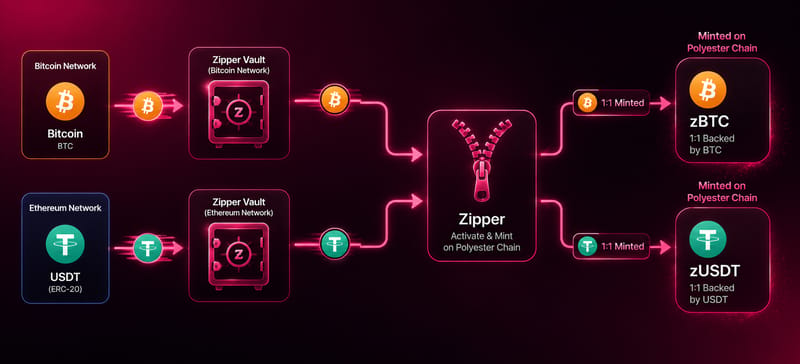
Users can send tokens from external chains to their deposit address, which end up in a Zipper vault on that chain.
Zipper secures these tokens, and 1:1 mints a zipped version of that token on the Polyester Chain.
Visit Zipper Overview for more details.
zAssets
When an external asset is deposited through Zipper, it is represented on Polyester Chain as a zAsset (Zipped Asset).
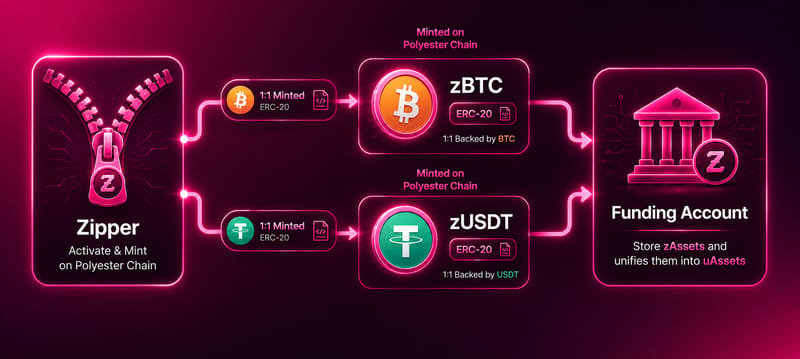
A zAsset is an ERC-20 token that corresponds to both a specific external asset and the blockchain that asset originated from.
zAssets are the canonical on-chain representation of external assets within the Polyester system. Each zAsset is backed 1:1 by an external asset secured and auditable in a chain-specific vault.
Funding Account and uAssets
After tokens from external chains arrive on Polyester, the exchange would still suffer from fragmented liquidity if those assets remained separated by chain.
This is solved by the Funding Account and uAssets.
Funding Account
The Funding Account is a hub of the Polyester Exchange. It is where zAssets arrive after being deposited and where unification occurs.
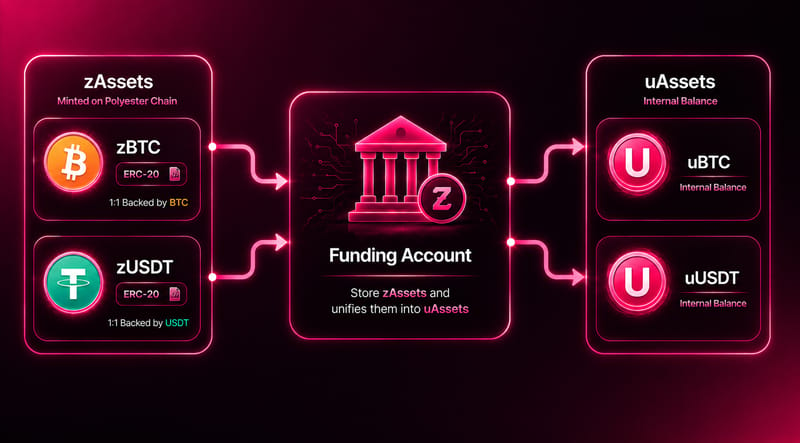
It is the boundary between asset representation and exchange usage. Outside of the Funding Account, assets remain chain-specific zAssets. Inside the Funding Account, they are converted into unified assets that can be used across trading and lending.
Visit Funding Account Overview for more details.
uAssets
zAssets correspond to both a token and an external chain. To combine the liquidity, zAssets are sent to the Funding Account where they are unified 1:1 into uAssets (Unified Assets).
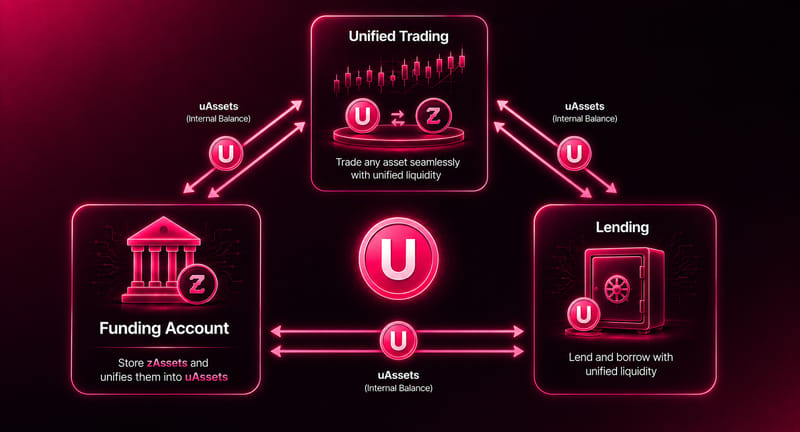
Within the Funding Account, eligible zAssets are unified into uAssets (Unified Assets).
uAssets are the internal exchange balances used for trading, lending, and borrowing on Polyester. A uAsset represents a unified view of a single underlying asset, regardless of which blockchain it originated from, and is backed 1:1 by one or more zAssets held in the Funding Account that also represent the same underlying asset.
uAssets are denominated using the base ticker shown throughout the interface, such as USDT or BTC. Users will never see "uUSDT" or "uBTC" in the UI. The uAsset terminology exists to describe how the exchange represents assets internally, not as user-facing tokens.
By unifying assets in this way, Polyester concentrates liquidity into fewer, deeper markets and avoids exposing users to a proliferation of chain-specific variants.
Smart Wallets and Authentication
With assets unified and liquidity consolidated, the remaining challenge is reducing friction in how users interact with the exchange without limiting capability or control.
This is solved by Polyester's use of smart wallets and flexible authentication via Turnkey.
Smart wallets
Each Polyester account is backed by a smart wallet on Polyester Chain. This wallet represents the user's on-chain identity and authorizes actions across the exchange.
Smart wallets allow Polyester to support more expressive account behavior, including subaccounts, permissions, delegated access, and other advanced workflows, while keeping interaction consistent across products.
Visit Smart Wallets for more details.
Turnkey authentication
Turnkey is an external authentication provider integrated into Polyester that enables flexible, secure account access. Users can sign in with email or a social account rather than managing private keys directly, while the account remains non-custodial under the hood.
Users who prefer to authenticate with a wallet can continue to do so; Turnkey is optional and does not replace wallet-based access.
Because accounts are backed by smart wallets, these authentication options do not change how assets, permissions, or account boundaries work within the exchange.
Visit Creating an Account for more details.
Bringing It All Together
Zipper and zAssets handle how assets enter Polyester from external chains. The Funding Account and uAssets unify those assets into shared balances. Smart wallets and Turnkey authentication define how users interact with that liquidity across trading and lending.
Once assets are inside the exchange, they can move directly between trading, lending, and vaults without withdrawals, redeposits, or protocol handoffs. Capital stays within the same environment, making it easier to deploy, reallocate, or manage risk without interrupting a workflow.
The remainder of the documentation builds on these concepts to explain how the exchange operates in practice.