Assets on Polyester follow a defined lifecycle as they move from external blockchains into the Polyester Chain, between Polyester exchange accounts, and back out to external chains.
Assets remain backed 1:1, auditable, and traceable at every stage, with clear custody boundaries throughout.
Internal Asset Terminology
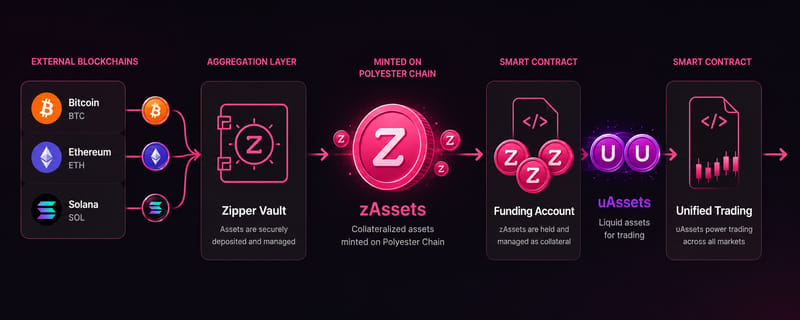
Within Polyester, zAssets and uAssets exist to make it obvious which side of the ecosystem assets exist in:
- zAssets refer to the assets on the Polyester Chain side that have been wrapped by Zipper and are backed 1:1 by external chain assets secured in their respective native vaults.
- uAssets refer to the assets on the Polyester Exchange side that have been unified by the Funding Account and are backed 1:1 by zAssets and that users trade, lend, and borrow with.
On Polyester.com, users interact with base tickers in the UI (USDT, BTC, etc). The zAsset/uAsset terminology exists in the docs and specific platform locations to keep the underlying custody and accounting model precise.
How Assets Flow Throughout Polyester
External asset deposit
Each Polyester smart account has a single, unique deposit address for each supported external blockchain.
The deposited asset exists entirely outside Polyester at this stage, subject to the confirmation rules and finality guarantees of the source chain (such as BTC, LTC, XRP, etc).
For details on supported chains, deposit addresses, and confirmations, see Deposits.
zAsset minting via Zipper
Once a deposit is confirmed on the original external chain, Zipper mints a corresponding 1:1 zAsset on Polyester Chain.
zAssets are fungible tokens implemented as smart contracts, with supply that adjusts dynamically: minted when assets are deposited into Zipper and burned when they are withdrawn. The process runs permissionlessly against the contract logic, ensuring transparent and predictable supply mechanics.
The external assets remain secured in a chain-specific and token-specific vault.
The zAsset serves as the canonical Polyester Chain representation of the deposited asset and its chain of origin.
zAssets cannot be traded, lent, or borrowed directly. They must first be deposited into the Funding Account and unified as uAssets to become usable on Polyester Exchange.
For more on Zipper’s role and guarantees, see Zipper Overview.
Funding Account deposit and uAsset creation
Newly minted zAssets are deposited directly on-chain into the Polyester Exchange Funding Account.
The Funding Account consolidates zAssets from multiple source chains that represent the same underlying asset into a single unified balance. It maintains a fully on-chain record of all deposits and withdrawals, tracking exactly which user each balance belongs to.
Once zAssets enter the Funding Account, they are recognized as uAssets: the unified balances used for all trading, lending, and borrowing across the exchange.
Example: If a user deposits 10 zETH from Base and 5 zETH from Arbitrum, the Funding Account unifies them and mints 15 uETH.
Because uAssets are chain-agnostic, trading pairs like BTC/USDC don't require USDC to be tied to a specific source chain. This eliminates liquidity fragmentation and enables unified lending pools that draw from all source chains without distinction.
For details on how the Funding Account operates, see Funding Account Overview.
Usage across exchange products
Once zAssets are converted to uAssets in the Funding Account, the deposit appears as complete in the user’s account.
From this point forward, all activity within the Polyester exchange operates exclusively using unified balances.
All zAssets and uAssets are fully transparent and verifiable on-chain. The total zAssets held in the Funding Account always match 1:1 with the total corresponding uAsset balances across the Funding, Trading, and Lending contracts.
Users transfer funds between the Funding Account, Trading Account, and Lending Account. All trading, lending, borrowing, and internal transfers use unified balances exclusively.
Withdrawal and lifecycle reversal
When a user initiates a withdrawal, they specify a destination chain and address. The Funding Account uses this to select the corresponding chain-specific zAsset, since uAssets are chain-agnostic and not tied to any particular native network.
In a single atomic on-chain transaction, the user’s uAsset balance is debited and burned within the Funding Account while the chain-specific zAssets are simultaneously transferred on-chain to Zipper to finalize the withdrawal.
Zipper then burns the received zAssets and releases the underlying assets on the corresponding destination chain to the destination address specified by the user.
This atomic burn-and-release flow ensures uAssets and zAssets are burned the moment a withdrawal is submitted, preventing duplication and maintaining 1:1 backing throughout.
For full withdrawal mechanics, see Withdraw Funds.
Lifecycle Guarantees
Across every stage of the lifecycle:
- zAssets are always backed 1:1 by external assets pointing to their respective source chain, secured in decentralized Zipper vaults.
- uAssets are always backed 1:1 by their corresponding zAssets held in the Funding Account.
- External assets (such as BTC, USDT, ETH) cannot be released from their Zipper vaults until their corresponding zAsset has also been burned on Polyester Chain.